Posts

Showing posts with the label share market

Savita Oil - Small Cap Company

Image
 #techno_funda_analysis Fundamental Analysis: Following Table shows the performance of all three major department of the business like.  Marketing Department. Finance Department Operations department. Let's more extend the marketing department performance as it is main department which generates revenue and responsible for any business profitability. If we see fundamentally the company's marketing department has shown a phenomenal growth rate of 44% CAGR. which is a good sign. Also EPS wise company has grown phenomenal rate. Earlier where they were generating 64 Rs. for every share now they can generate159 Rs. per share.  Altman Z-Score -4.70( Good For Solvency) Piotroski F-Score - 7 ( Good for performance as compared to last year) Modified C-Score - 4 (There might be a chance of accounting manipulation)  Technical Analysis: Good time to consider the stock as an entry point as per technical analysis.
Accumulation VS Distribution Phase

Image
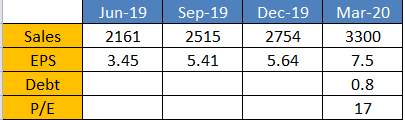
  How to know if the stock of a company is in 'Accumulation Phase' or Distribution Phase'?   This is a very common question every investor asks before an investment in value stocks. Sometimes what we see is stock, take the move and go sideways so it becomes difficult for an investor  to identify whether this sideways phase is for accumulation or distribution and how we should understand this ? Here is the simple trick with the help of which you can easily identify the stock phase. There are three major players (Smart Money) which play an important role in shareholding of any company. a) Promoter. b) Mutual fund or Insurance companies. c) FIIs (Foreign Institutional Investors) So let us understand how we will identify smartly which company is good for investment. Step 1: Find a good fundamental company.( Smartly) a. Sales must be increasing. b. EPS should be increasing. c. Low debt. d. P/E should be less than industry. eg. KEC intnl. Step 2: L...

Emotions Vs. Logic Stock Market Trading.

Image
 Why do most of the traders fail to make money? Can a 12th pass candidate earns millions from the stock market...   Emotions play a very crucial role in trading in the stock market. I have observed that many times a well educated person (i.e. Technical Analyst) fails to make money and a common person who knows nothing about it but basics does wonder.  How does it happen? See, Stock Market is filled with the numerous of brains which comprises of several major emotions which every human being does carry i.e. Fear, Greed, Anger and Hope. And these emotions have no link with the education qualification of any person. A highly graduated masters degree holder or a normal graduated person both can have these emotions. Major winner will always be the person who will manage their emotions, not the one who is more qualified. Briefly understand how the market works, Whether you agree or not but it is true, Market is moved by market makers (20% people have la...

Bitter Truth Of Stock Market

Image
  Truth behind trading in the stock market. There are a lot of advisors in the stock market (i.e. so called 'Technical Analyst') who keep predicting levels of the security weather it is a 'Stock' ( e.g. Reliance, Tata motors, Cipla etc.) or an 'Index' (e.g. Nifty, Bank Nifty etc..) with so much of conviction that you can't stop yourself besides believing to those. My first question is how can you predict the price? There are not only a few people who are making the price but billions of people's minds are working behind the price movement. How can you read those minds?  Anyhow they start predicting with daily price levels, weekly price levels, monthly price levels and so on. Which is leading to people a tendency of speculation.  Just try to understand what happens in the stock market. These people predict the price with so much of conviction that you have no other choice but to believe them. When the price goes up they come up as a 'HERO' . Hey !...

Trading with insiders not with masses

Why do retail investors always suffer with losses? Are "Institutional Investors" the only one who has the right to make money?  These types of so many questions I was asking to myself and when you ask questions there is an answer. I was reading a very nice book where a concept of 80/20 pareto principle was nicely explained. I would like to summarize the whole book concept and betting that it will definitely help you provide an edge in investing. Firstly, I would like to brief you about Pareto principles. What does it say?  This is the principle of "Vital Few" which says 80% consequences come from 20% causes. It applies everywhere. Firstly, it is observed in 'ITALY' where 80% of land was occupied by 20% of the population. Another observation is that 20% is the conclusion of the whole book, 20% of your clothes you wear 80% of the time. Remember it is not a thumb rule but is just an observation and this simple observation works  wonders in the 'Stock Market...

Economic indicators and their impact on stocks !

Image
Economic Analysis Economic Analysis is the primary term or factor which is used before any kind of investment. It stands first in top-down approach i.e EIC (Economy | Industry | Company ) So it should not be ignored as it plays a vital role to impact the stocks and their performance. There are few indicators which tell us about the economic condition, what is going into the economy and how they impact the business. These indicators can be found easily on google on different websites. One and popular website for these information is Trading Economics. Caution: The accompanying chart merely serves as a handy guide  and should not be construed as an accurate predictor in all cases. Many times the  anticipation of good or bad news is built into the market and when the news comes  out, the reverse move happens. Investor Choices

Book value, Face value and Market value of a share

Image
Difference between face value, book value and market value. Let us understand these all terms with an example of a story so that you never face any problem regarding these terms in future. There are three friends A, B and C. They start a new business with the capital of 10 lakhs. In which A contributes the capital of  5 lakhs, B contributes the capital of 3 Lakhs and C contributes the capital of 2 lakhs.  They think that they might have faced problems of capital transfer and distribution in the near future if they were required to add another person in the business. So they divided their capital into 1 lakh shares of 10 rs each. So this 10 rs is called face value which is their initial investment.  Now they continue the business and next year they earn the profit of 10% in their capital. They want to grow their business so they don't withdraw completely but 50% of their profits. Hence next year their capital becomes 10 lakhs plus 50 thousands profits.They c...

How to classify the industry (Growth, Cyclical, Defensive) manage your risk with proper diversification.

Image
 Want to invest in the Stock Market but am confused about which INDUSTRY  should I invest in??? This is for you ! Industries basically work as per the Economy's (Expansion/Contraction) There are 4 types of industries. 1. Growth Industry :   New Start-up Stage in Industry Life Cycle Solid Earning Figures Risky Stock High Return.   2. Cyclical Industry: Growth is dependent on Expansion and Contraction Of economy. Include those that produce durable goods or heavy equipment. People spend more when they have good income. E.g.. Airline   3. Defensive Industry: Food Processing Industry. Provides necessities for consumers withstand recession and depression. E.g.. FMCG   4. Cyclic Growth Industry: Both characteristics of Cyclical and Growth Industries. Change in technology and intro of new models help them resume growth. E.g.. Automobile .   Everyone wants to beat the benchmark. It can be Nifty 50, Nifty Mid Cap or any other INDEX.   So attached video...

How to analyse the management of the company ?

Image
Company Analysis! Qualitative Analysis Why do retail investors always fail to pick the quality stock?  Why does it become so necessary to look at the management as a whole before any kind of an investment? "New Car - Bad Driver - Definitely there will be an accident. Old Car - Good Driver - Definitely you will reach the destination." Fundamental Analysis of any company starts with 'quality analysis' followed by 'quantity analysis' Quality analysis of any company is more subjective however quantity analysis is more objective and numeric. Everyone says see the management but nobody talks about how to see the management. We will  analyse the management as a whole not in a very concentrated way. Which means we will divide the management into many small parts and then will use the method of 'sum of the part' . So let us discuss how to watch management. There are so many parameters which an investor can look before an investment. But there are few key parame...

High ROE vs Low ROE! What is the concept of ROE ? Normal and Extended Du-Pont analysis

Image
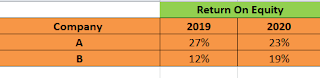
Extended Du-Pont Analysis (The concept of ROE)   Two companies having following ROE which will you buy? Other things are constant.   Definitely an investor will prefer company A as other things are constant. But this will be an irrational behaviour firstly we will go to the root of ROE from where the value has been derived .    Normal DU-Pont Analysis   Extended Du-Pont Analysis   Now Let us understand each parameter one by one. a. Tax Effect : It shows how much the tax a company is paying. If these figures are heavily mismatching then there can be a huge possibility that they are making manipulation in taxes to show profits more. Should not be fluctuated more.   b. Financial Leverage Effect. It shows what the effect of leverage is having upon the profitability of the company.Increasing is better as company is paying less debt In the figure above if we see Company B already has a high leverage effect i.e...

How to trade in sideways market? Options Trading (Butterfly Spread)

Image
Butterfly spread ! Market Looks Like Sideways ? Want to trade but with proper risk management. Before an application of butterfly spread you must have a market view as non-volatile. Yes my friend it only works in non-volatile markets.   How to apply practically in the market.?? Which Strike price is required to select ? Let's understand, Many times we see different-different opinions in news channels and on social media that the market will be bullish from there or the market will be bearish from there but if you have understood the market behaviour you will be able to draw your own opinion. And if your opinion is sideways than you are the perfect one who can get benefit from this strategy. For Example: Company A CMP: 2700 Formation: Buy - Cash Outflow Sell - Cash Inflow Major condition : Choose strike price only on the basis of uniformity i.e difference between each strike price should be equal in this case i have taken the difference of 300. You can take 100, 200, or 30...

2 most popular investment style ! Value Investing or Growth Investing

Image
One wrong investment can evaporate all your savings, and one right investment can grow you like anything !  Very nice saying " The stock market is filled with individuals who know the price of everything, but the  value of nothing. ~ Philip Arthur Fisher When we talk about wealth creation it becomes necessary for us to understand what are the investment styles people have used in the past to create wealth.   And the answer is- There are broadly two most popular investment styles 'Value Investment' and 'Growth Investment'   1) Value Investment style:   Warren Buffet the master of Investment is majorly focused on value investing strategies. These strategies are for a long term basis and investment is done only those stocks which have just started performing good but price is not moving up or falling down.These stocks will be available at low Price to earning  and their 'intrinsic value' will be higher than 'market price'. Companie...

What is good P/E ratio ? Invest In High P/E Or Low P/E Stocks

Image
Price to earnings ratio (P/E) Overvalued Or Undervalued???  Most common and wrongly interpreted term in the finance industry. Let us understand the concept of P/E   If the P/E is higher than that of comparable firms, it is said to be relatively overvalued, that is, overvalued relative to the other firms ("Not necessarily overvalued on an intrinsic value basis"). The converse is also true: if the P/E is lower than that of comparable firms, the firm is said to be relatively undervalued  ("Not necessarily undervalued on an intrinsic value basis"). Price to earnings is the ratio which shows how much respect the market is giving to a particular company for his future potential. Example: If P/E is 20 it means i am ready to pay 20 rs for every 1 rs earnings. Let’s move on a case study to understand the concept . Industry - Information Technology. Company A - P/E 20,  Sales - 100 Lakhs, Profits- 20 Lakhs Company B - P/E 80 , Sales -100 Lakhs, P...